
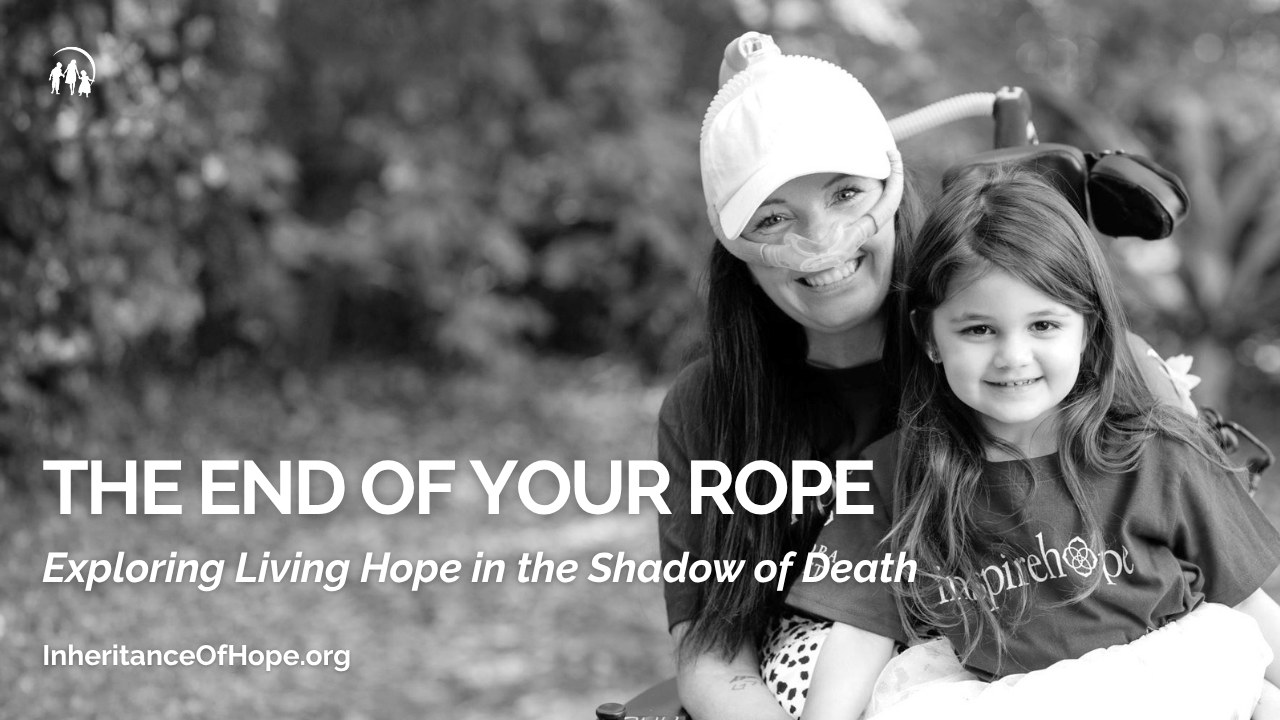
Do you feel like you have finally come to “the end of your rope”?
Visible and invisible burdens occur from everywhere, all the time, all at once. You find yourself barely clinging to the final tattered threads, and it is harder and harder to hold on.
Resources are becoming scarce.
Physical energy is entirely depleted.
Patience is running dangerously low.
Each day brings more questions than answers.
You are just plain exhausted from navigating life with a terminal illness.
A quick glance at the calendar shows upcoming appointments (that will probably end up being rescheduled). Prescription refills are waiting to be picked up at the local pharmacy, and voicemails from doctors need to be returned.
You require constant care, but so do your children. In between baths, meals, and meltdowns, there is a mountain of laundry screaming for attention (you know—it’s that pile of socks and shirts appropriately named “Mount Never Rest.”)
Let me ask you a crucial question: “What is at the other end of your rope?”
There has to be something anchoring you and holding weight at the other end of the line. Maybe you know exactly what it is. Or maybe you have never stopped to consider this question.
Many people around you are clinging to a rope which is tethered to something called Common Hope. This kind of hope is “wishful thinking” or having an “optimistic outlook.”
Well-meaning people walk up, hold your hand and say:
-
- “I hope the surgery goes well.”
- “I hope that your recovery is quick.”
- “I hope you have a safe trip.”
- “I hope you get a good report.”
But underlying Common Hope is a terrifying chasm of unknowns and uncertainties about the future. Whatever happens next is completely dependent on luck, shifting external circumstances, human calculation or vague cosmic intervention. Any semblance of hope is nothing more than a high-stakes gamble.
Here’s the problem with Common Hope—it is completely based on temporary outcomes. When those temporary circumstances fall apart, hope vanishes right along with them.
Thankfully, there is another kind of hope.
A better hope.
The best hope.
Biblical Hope.
No gambling, unknowns, uncertainties, or room for doubt. How can that possibly be true? After all, no one knows how everything will turn out.
One of the original words used for “hope” in the Bible describes a thick rope under immense tension while holding a heavy load. Think of a ship’s line being held tight to an anchor. When a brutal storm rolls in, the ship survives because the anchor is buried deep in something immovable far beneath the crashing waves. Even when the vessel is tossed violently and the rope groans under the strain, that hidden anchor connection keeps it from drifting into the rocks.
Biblical Hope involves enduring this tension to actively wait with complete trust and dependency on God. This waiting isn’t a passive surrender to despair, but an active, expectant clinging to the character of a faithful God. It means resting in the quiet confidence that even when your physical hands are too weak to hold the line, His grip remains completely unbreakable.
-
- “I waited patiently for the Lord to help me, and he turned to me and heard my cry.” (Psalm 40:1)
- “But those who trust in the Lord will find new strength. They will soar high on wings like eagles. They will run and not grow weary. They will walk and not faint.” (Isaiah 40:31)
- “The Lord is good to those who depend on him, to those who search for him.” (Lamentations 3:25)
- “I waited patiently for the Lord to help me, and he turned to me and heard my cry.” (Psalm 40:1)
Biblical Hope is filled with eternal Truth found in the Bible, not to the temporary, fading and breaking things of this world. It is important to remember that most of what we fill our lives with simply does not last forever. Temporary things will always disappoint and fall short of meeting our deepest needs. Not so with the words of Jesus.
-
- “Heaven and earth will pass away, but my words will never pass away.” (Matthew 24:35)
Biblical Hope is living hope. Christ is the Ultimate Anchor who defeated death, rose from the dead, and promised to come again. He is alive, and therefore the hope He brings is alive. We can have a living hope because it rests entirely on the reality of a living Savior.
-
- “But the angel said to the women, “Do not be afraid; I know that you are looking for Jesus, who was crucified. He is not here, for he has been raised, just as he said. Come and see the place where he was lying.” (Matthew 28:5-6)
- “But the angel said to the women, “Do not be afraid; I know that you are looking for Jesus, who was crucified. He is not here, for he has been raised, just as he said. Come and see the place where he was lying.” (Matthew 28:5-6)
-
- “Blessed be the God and Father of our Lord Jesus Christ. Because of his great mercy he has given us new birth into a living hope through the resurrection of Jesus Christ from the dead.” (1 Peter 1:3)
What does all of this mean? God is inviting you to explore Biblical Hope, even in the midst of a terminal illness, even in the shadows of death. I urge you to take Him up on His offer.
As a parent, you aren’t just trying to keep yourself steady; you are trying to steady a ship that holds your spouse and your kids. You don’t have the human strength to hold the ship still by pulling on the line yourself. True Biblical Hope means realizing that you don’t have to. There is a tether to an Anchor which holds the ship–which means the Anchor holds you, your spouse and your kids, too.
As you reflect on exploring living hope in the shadows of terminal illness, take some time to honestly answer these questions:
-
- Have I been holding onto Common Hope or Biblical Hope?
- Which of these verses about Biblical Hope should I memorize while navigating terminal illness?
- Have I surrendered the future of my children into the hands of the Savior, trusting Him to anchor them even when I cannot?
- Have I been holding onto Common Hope or Biblical Hope?
A Closing Prayer
Heavenly Father,
There are days when I look down at my hands and realize I have come to the end of my rope. I am barely holding on. And it’s not just me. My spouse and the children You gave us are barely holding on as well.
I confess that the temporary stuff of life gets in my way. Sometimes that’s exactly what I end up clinging to. I am desperate for some kind of relief. But at the end of the day all the questions and unknowns leave me more exhausted than before.
Teach me what it means to actively wait on you. Not with partial trust. But with complete trust, open handed and surrendered to Your will. This doesn’t come naturally for me, so I need You to do a supernatural work in me that I cannot do on my own. Let my kids see it so that they will grow up completely trusting in You, too.
Today, I am not placing my hope in a good report, a safe trip, a quick recovery or an effective treatment. I want my hope to be solely anchored in Jesus Christ, my living hope. One day, He will return and make all things new. Until then, increase my faith.
Amen
Brad Neese is a pastor, teacher and leader dedicated to aligning people to the truth, relevancy and everyday implications of the Gospel. He graduated from Cedarville University and Dallas Theological Seminary, spending over two decades shepherding congregations and developing church leaders. He currently lives in Irmo, South Carolina, with his wife, Crystal, and their four children.