
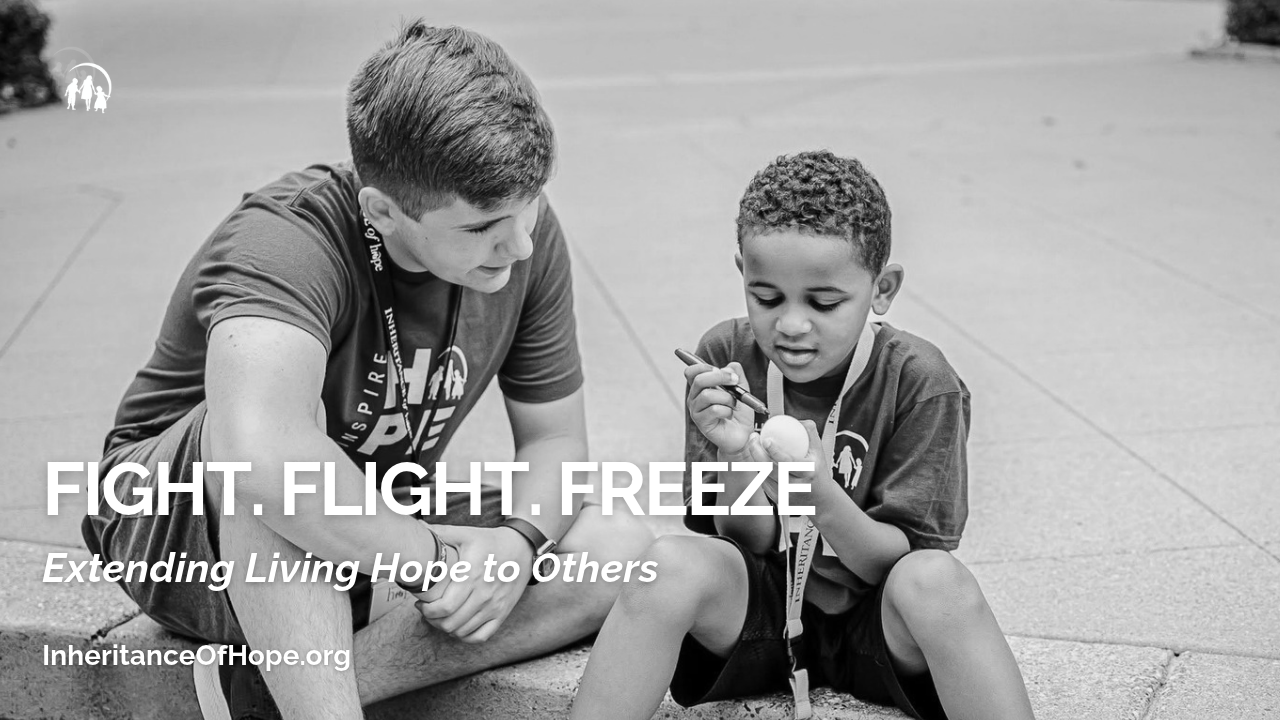
Fight.
Flight.
Freeze.
Those are three common reactions when we are caught off guard. Think about coming face to face with a massive spider, or slithering snake, or looking down from a terrifying height. You know the feeling.
Scientifically speaking, the emotional center of your brain sends a distress signal to your hypothalamus. This tiny command center then fires off emergency orders to the rest of the body through the nervous system. In an instant you either gear up to Fight, sprint into Flight, or lock up and Freeze.
Those same three reactions happen when you open a door, step into a room and look into the eyes of someone facing terminal illness.
Fight isn’t about physical aggression, but the urge to fix, remedy or solve the deeply complex problems a terminally ill person is facing. Their condition is a medical riddle to be solved, a broken object to repair, or a quaint anecdote for healing. A tremendous amount of energy is consumed with fixing something that cannot be fixed.
Flight means looking for the nearest exit. Getting as much distance—physically, emotionally, relationally—as possible from the situation is top priority. Running away seems to relieve a major amount of discomfort.
Freeze makes minds go completely blank. Stares linger longer than they should. Words don’t form. Lips don’t move. It is as if someone pushed the “Pause” button on life. Just awkward silence, robotic actions and looking around for a substitute.
What is your default setting when you are face-to-face with someone who is terminally ill? Do you roll up your sleeves to solve and fix? Do you quietly back out? Do you pray for someone to take your place?
Thankfully, there is a fourth option to be explored: Fulfill.
Instead of reacting out of Fight, Flight or Freeze, we can choose to fulfill the law of love.
When asked about the Greatest Commandment, Jesus replied:
“…love the Lord your God with all your heart, with all your soul, with all your mind and with all your strength. The second is this: Love your neighbor as yourself.” (Mark 12:29-31).
Fulfilling these two commandments should be at the top of our life’s checklist, but for a moment let’s focus on loving your neighbor as yourself.
A “neighbor” is not merely someone who lives on the same street, in the same neighborhood or same apartment building as you. But rather, a neighbor is anyone God places in your path. Friends. Family. Foe. Strangers. People with a terminal illness.
To Fulfill this commandment means that we show up, lean in and seek to meet the needs of the person in front of us, even if our natural response is to fight, flee, or freeze.
Jesus gave us a beautiful picture of this in the story of the Good Samaritan. A simple summary:
A traveler is robbed, beaten and left for dead. Two religious leaders walk by, see the man and just keep walking. A third man handles the situation completely differently. We aren’t given his name. We only know him as: The Good Samaritan. The Good Samaritan’s response is so revolutionary that laws were named after him which encourage bystanders to offer assistance to people in distress.
Take a moment and read Luke 10:25-37 before continuing and become familiar with all of the elements of the story of the Good Samaritan.
There are two ways that the Good Samaritan Fulfills the commandment to ”love his neighbor.”
-
- First, the Good Samaritan felt compassion.
There was a heart of deep, deep empathy for that beaten man. It was the same kind of compassion that welled up within Jesus when He saw a weeping widow burying her only son (Luke 7:13) and how a loving father felt when he spotted his renegade son walking up the road back home (Luke 15:20).
In contrast, the two religious leaders felt absolutely nothing. Nada. Zilch. Cero. They opted for Flight mode, totally and completely avoiding the beaten man by crossing over and walking on the other side of the street!
Why did the Good Samaritan feel deep compassion for this beaten man? He didn’t know the man’s background, the man’s name, what happened earlier that day, or whether the man deserved the beating. The Good Samaritan saw a fellow human, made in the likeness and image of God, suffering—something God never intended for humanity.
-
- Secondly, the Good Samaritan showed compassion.
The Bible records no dialogue between these two men. Words were not necessary; only action.
He located the beaten man. The Good Samaritan walked right into the mess. He went up to the beaten man, bandaged his wounds, got up close and personal, dirtied his hands, and used his own resources.
But that’s not all.
He re-located the beaten man. The Good Samaritan placed the beaten man on his own animal and walked alongside. The journey became much slower and more inconvenient. All of this took the costliest commodity all of us have a limited supply of: time.
When they arrived at an inn, the Good Samaritan never left the beaten man’s side. He probably stayed up all night tending to the man’s wounds, helping him eat, drink, and watching him just breathe. When the sun came up, the Good Samaritan made sure the man was taken care of until fully recovered.
What does all this mean?
When we step into the room and see someone with a terminal illness and offer radical, self-sacrificing compassion, we are actually fulfilling our call to love our neighbor as ourselves. Loving our neighbor should provide evidence that transformation has taken place in our hearts as a result of trusting in Christ. It is only then that we can fulfill not just the second commandment, but the first commandment as well.
In the story of the Good Samaritan, we learn that:
Compassion involves both feeling and showing—these are inseparable. You cannot have one without the other and still Fulfill the command to “love your neighbor as yourself.” Compassion without feeling is a heartless ritual. Compassion without action is hollow sympathy.
Compassion needs no explanation. It bypassed all the questions and only saw the person. There is no judgment. No lectures. There are no teachable moments. There is no preaching. There is no flow chart to analyze how all of this happened. Just pure, quiet compassion in action.
Compassion provides Hope. All of the sacrifices involving time and resources have a greater goal than addressing physical, emotional and social needs. Introducing people to Christ is the ultimate fulfillment of loving our neighbors. And this is possible by living life from a heart that has truly been transformed by Christ.
Reflection Questions:
- When you enter a room and see someone with a terminal illness, what is your natural reaction? Fight? Flight? Freeze? Fulfill?
- Think of the last time you felt deep compassion for someone who is terminally ill. Did that feeling find its way into tangible action?
- What is one practical way you can show compassion to someone in your life who has a terminal illness?
A Closing Prayer
Heavenly Father,
You created me, and you know how I respond when I see someone who has a terminal illness. I can’t hide my reaction from you. And while it may be natural for me to go into Fight, Flight or Freeze modes, You desire something greater—a response which reflects Your heart.
I’m asking you to change the way I respond. I don’t want to Fight, Flight or Freeze. I want to Fulfill. Not so that I can become a better human being, but to make my actions consistent with faith in Your Son, Jesus. He is the ultimate example of compassion. Make me more like Him.
Please use me to provide Hope for anyone whom you place in my life.
Amen.
Brad Neese is a pastor, teacher and leader dedicated to aligning people to the truth, relevancy and everyday implications of the Gospel. He graduated from Cedarville University and Dallas Theological Seminary, spending over two decades shepherding congregations and developing church leaders. He currently lives in Irmo, South Carolina, with his wife, Crystal, and their four children.